How to Find a Cofounder in Spain
By Mickey Soto, CEO · · Leer en español
Cadena Hub | Guides | 8 min read
Choosing a cofounder is one of the biggest decisions you will make as a founder, and one of the least planned. Many people end up building a company with whoever was nearby when the idea appeared. Knowing how to find a cofounder in Spain, and how to test the fit before you sign anything, can save you years of friction and a lot of equity.
This guide covers whether you need a cofounder at all, where to look in Spain, a simple way to test the partnership before you commit and what to agree on paper. It is written for founders, CEOs and senior professionals who want a partner they can build with for the long run. If you are new to the Spanish ecosystem, start with our guide to networking for founders in Spain.
Do you actually need a cofounder?
Not every company needs one. The Mapa del Emprendimiento 2025 by South Summit and IE University found that 23% of Spanish startups now have a single founder, up from 7% in previous editions. Teams of two or three founders are still the most common model, at 60% of startups.
The same study found that 30% of entrepreneurs in Spain come from another startup, either as founders or as employees. In other words, many cofounders meet at work long before they start a company together.
Signs you need a cofounder
A critical skill is missing. For example, you sell well but nobody on the team can build the product.
The workload is more than one person can carry. Not for a month, but for the next two or three years.
You want a partner in the hard decisions. Someone with the same level of commitment and the same risk on the table.
Signs you might be better solo for now
You need help, not a partner. A freelancer, adviser or first hire may solve the problem without sharing ownership.
You are searching out of loneliness. A peer group or a founder community can give you support without a legal commitment.
What to look for in a cofounder
Complementary skills
The best partnerships cover different ground. A product builder and a seller, an operator and a visionary. Two people with the same profile often end up competing for the same work.
Shared values and ambition
Talk early about how big you want the company to be, how fast you want to grow and what you would do if a buyer appeared in year three. Different answers are fine. Hidden answers are not.
Commitment and risk appetite
Agree on hours, salary expectations and personal runway. A cofounder who needs a full salary from month two is in a very different position from one who can wait a year.
How they handle conflict
You will disagree. What matters is how you disagree. Watch how the other person reacts when you push back on an idea.
Where to find a cofounder in Spain
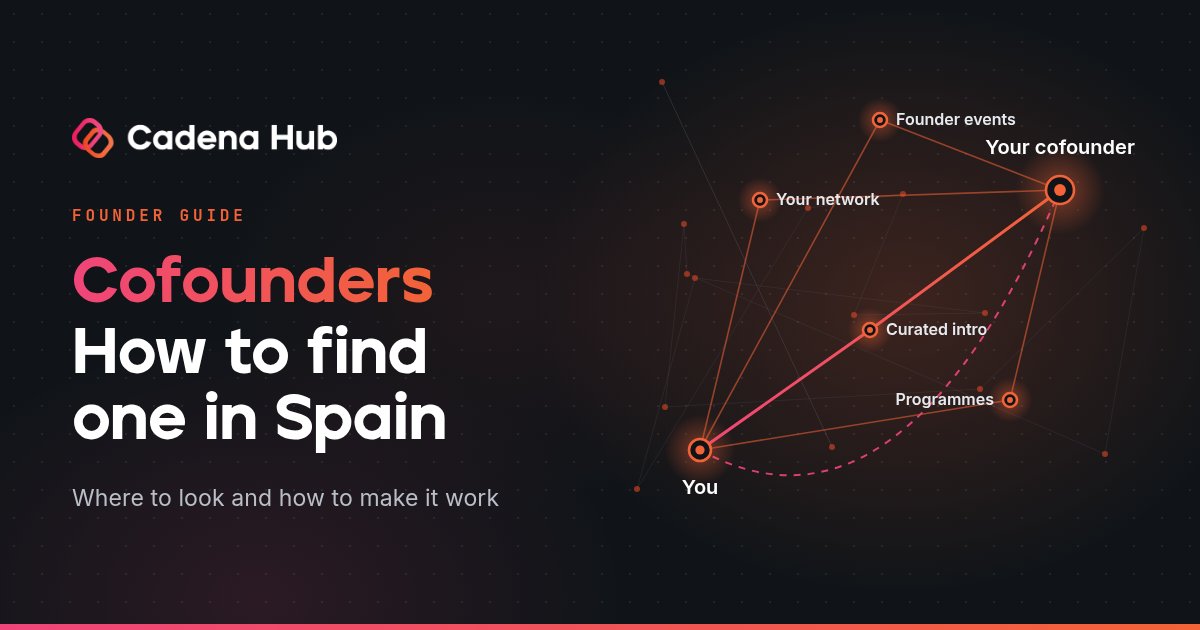
1. Start with your own network
Former colleagues, clients and people you have already worked with are the safest place to start, because you have seen how they behave under pressure. Make a list of the ten people you would trust most with a hard problem and have a coffee with each one.
2. Go to founder events and communities
Recurring founder meetups are full of people looking for a project or a partner. Startup Grind has chapters across Spain, and some community formats, such as HUSTLE in Málaga, say openly that your next business partner could be in the room. Our guides to networking events in Madrid and Barcelona show where to start.
3. Look at accelerators, programmes and universities
Accelerators, startup programmes and university entrepreneurship centres bring together people who have already decided to build something. Some investors back founders before the team is complete. In January 2026 the Madrid-based Demium rebranded as Mission and announced a 35 million euro pre-seed fund for Spanish startups, according to EU-Startups.
4. Use online cofounder matching
Platforms such as Y Combinator's Co-Founder Matching let you create a profile with your skills, interests and location and then browse filtered profiles. They are global, so filter carefully by city and language, and move to a video call quickly.
5. Ask for curated introductions
A warm introduction from someone who knows you both is still one of the best ways to meet a potential partner. Our guide on how to ask for an introduction has templates you can copy.
How to test the fit before you commit
1. Work on a real project together
Spend four to eight weeks on something concrete, such as customer interviews, a prototype or a first sales push. You will learn more in a month of real work than in a year of coffees.
2. Have the hard conversations early
Talk about money, roles, titles, who has the final say in each area and what happens if one of you wants to leave. Write the answers down.
3. Meet the people around them
Talk to former colleagues or partners, and ask how they work under pressure. If they would not ask the same of you, that is worth noticing.
4. Agree how you will decide
Decide in advance who leads on product, sales, finance and hiring, and how you will break a tie. Most cofounder fights are about decisions nobody owned.
What to agree on paper in Spain
This section is a starting point, not legal advice. Talk to a lawyer who works with startups before you sign anything.
A shareholders' agreement (pacto de socios)
A pacto de socios sits alongside the company's bylaws and sets out roles, how key decisions are made, what happens if a founder leaves and how shares can be sold. It is the document you will be glad you wrote if things go wrong.
Vesting and a cliff
Vesting means each founder earns their shares over time. A common structure is four years with a one-year cliff, so a founder who leaves in the first year keeps no shares. It protects everyone, including you.
The equity split
Avoid a default 50/50 without discussion. Look at who contributes what, now and over the next few years, and agree a split you would both still accept in three years' time.
The Startup Law
Spain's Ley 28/2022, known as the Startup Law, gives certified startups a reduced corporate tax rate of 15% for the first year with taxable profit and the three years after, according to the Agencia Tributaria. It also exempts shares and stock options given to employees up to 50,000 euros a year, which helps when you bring in a later cofounder or key early hire.
Mistakes to avoid
Splitting equity on day one without vesting. It is the most common and most expensive mistake.
Choosing a friend for the friendship. Friendship helps, but it does not replace complementary skills.
Leaving roles vague. Two CEOs is a recipe for conflict.
Skipping the trial period. A short project together reveals what a long conversation cannot.
Let the right people find you
Searching for a cofounder works, but it depends on meeting enough of the right people. That is the problem we built Cadena Hub to solve. It is a curated B2B network with its HQ in Madrid, going global, for founders, operators and professionals across Spain who want real collaboration, not mass networking. Here is how it works.
A new match every week. One curated 1:1 introduction to a vetted member, generated every Monday and booked for you. You can change the time if it does not suit.
Your monthly Hub. A group of four to six members from different sectors who connect, collaborate and grow together.
Collaborations. Post a need or an offer, such as a partnership or a co-development project, and apply to other members' posts. The section was recently revamped to make posting and applying more intuitive.
Partner rewards. Membership unlocks exclusive benefits with our partners, including 1 free day at partner coworking spaces when you work from another city, part of our coworking network across Spain.
Every member applies and is personally reviewed, so every introduction starts with someone worth meeting.
Want to meet the founders and operators worth building with? Apply for access to Cadena Hub.
Frequently asked questions
Where can I find a cofounder in Spain?
Start with your own network of former colleagues and clients, then go to recurring founder events, accelerators and university programmes. Online platforms such as Y Combinator's Co-Founder Matching and curated networks add reach. Whatever the source, test the fit with a short real project before you commit.
How do I find a technical cofounder?
Go where developers already meet, such as tech meetups, hackathons and university engineering programmes, and show progress on the business side first. Technical cofounders are more likely to join a founder who already has customer interviews, a clear problem and early traction.
How much equity should a cofounder get?
There is no fixed rule. Look at what each person contributes now and over the next few years, including skills, time, money and risk. Agree the split openly, put it in writing and protect it with vesting.
What is vesting and do I need it?
Vesting means each founder earns their shares over time, often over four years with a one-year cliff. It protects the company and the remaining founders if someone leaves early, and many investors expect it.
Do I need a shareholders' agreement in Spain?
It is strongly recommended. A pacto de socios sets out roles, decision-making, exits and share transfers, and it is far easier to agree before there is a problem. Ask a startup lawyer to draft or review it.
How can Cadena Hub help me find a cofounder?
Cadena Hub introduces you to one vetted member every week, matched to what your business needs, and its Collaborations section lets you post partnership and co-development opportunities. It does not replace your own judgement, but it puts more of the right people in front of you. See how it works and our FAQ.
Build with the right partner
Finding a cofounder is not about luck. It is about knowing what you need, meeting enough of the right people, testing the partnership with real work and putting the agreement on paper early. Do that, and you give your company a much better chance of lasting.
If you want to meet more of the right people every week, apply for access to Cadena Hub. Every application is reviewed personally. Quality over volume, always.
Also available in Spanish. Leer en español.